
Hail · Wind · Leaks
After the storm, get the real picture.
Storm damage hides. We get on the roof, photograph every hit and lifted shingle, and tell you straight whether it looks like storm damage, before you call anyone.
- Free inspection with photos
- Straight answers on insurance
- You keep your claim
What hail and wind do to a roof
Hail bruises shingles, knocks off the protective granules and can crack the mat underneath. The shingle may look fine for months, then start to fail as sun and water get in.
Wind lifts shingles and breaks the seal that holds them down. A lifted shingle can lay back flat and look normal from the ground, then blow off in the next storm.
Both are easy to miss without getting on the roof.
What we do
- We inspect for free and photograph every slope, hit and lifted shingle.
- We tell you straight whether it looks like storm damage or normal wear.
- You decide whether to file a claim. Looking at your roof does not file one.
- If your adjuster is coming, tell us the date. We'd like to be on the roof so nothing gets missed.
Straight talk on insurance
We don't give away free roofs, and nobody honest does. On an approved claim, you still pay your deductible. We never pay, waive or rebate any part of your deductible. It is part of your contract with your insurer, and covering it can put your claim at risk.
You file the claim. Your insurer decides coverage. We document your roof and build it.
Active leak after a storm?
Call or text (330) 800-7947 and tell us it's leaking. We'll get you on the schedule as a priority.
See it for yourself
Every slope, photographed
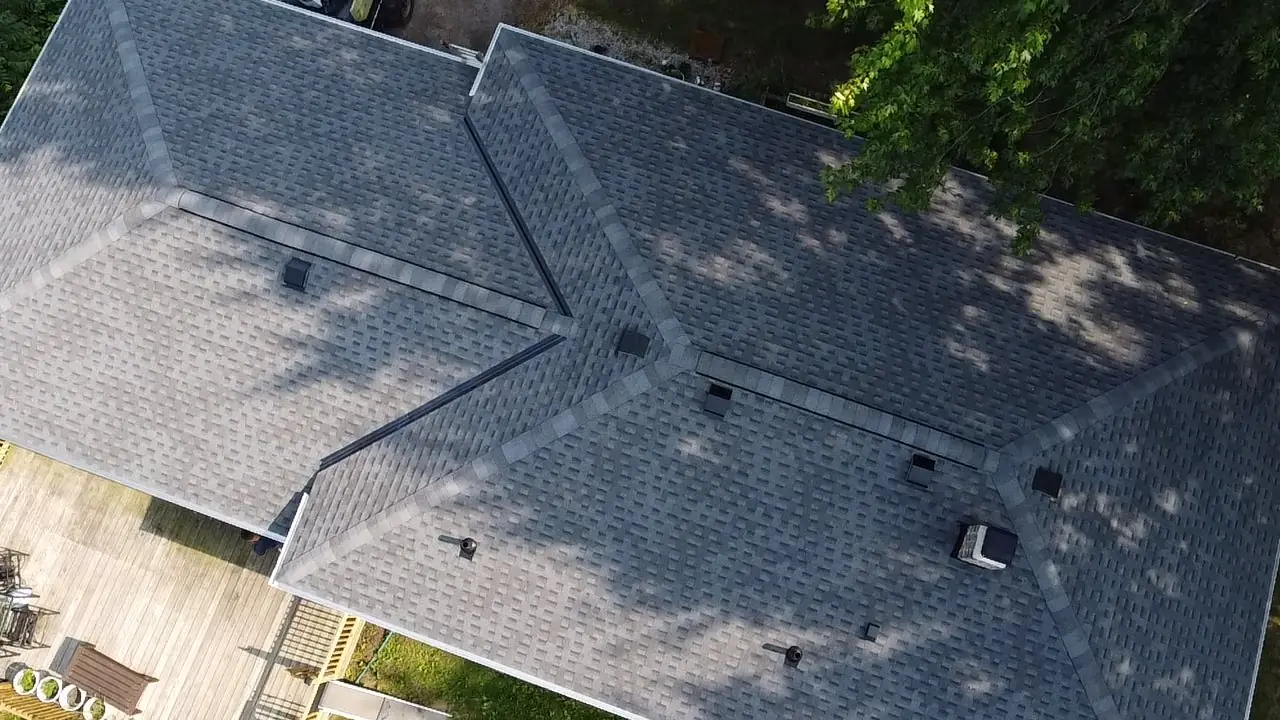
Storms hit some slopes harder than others. 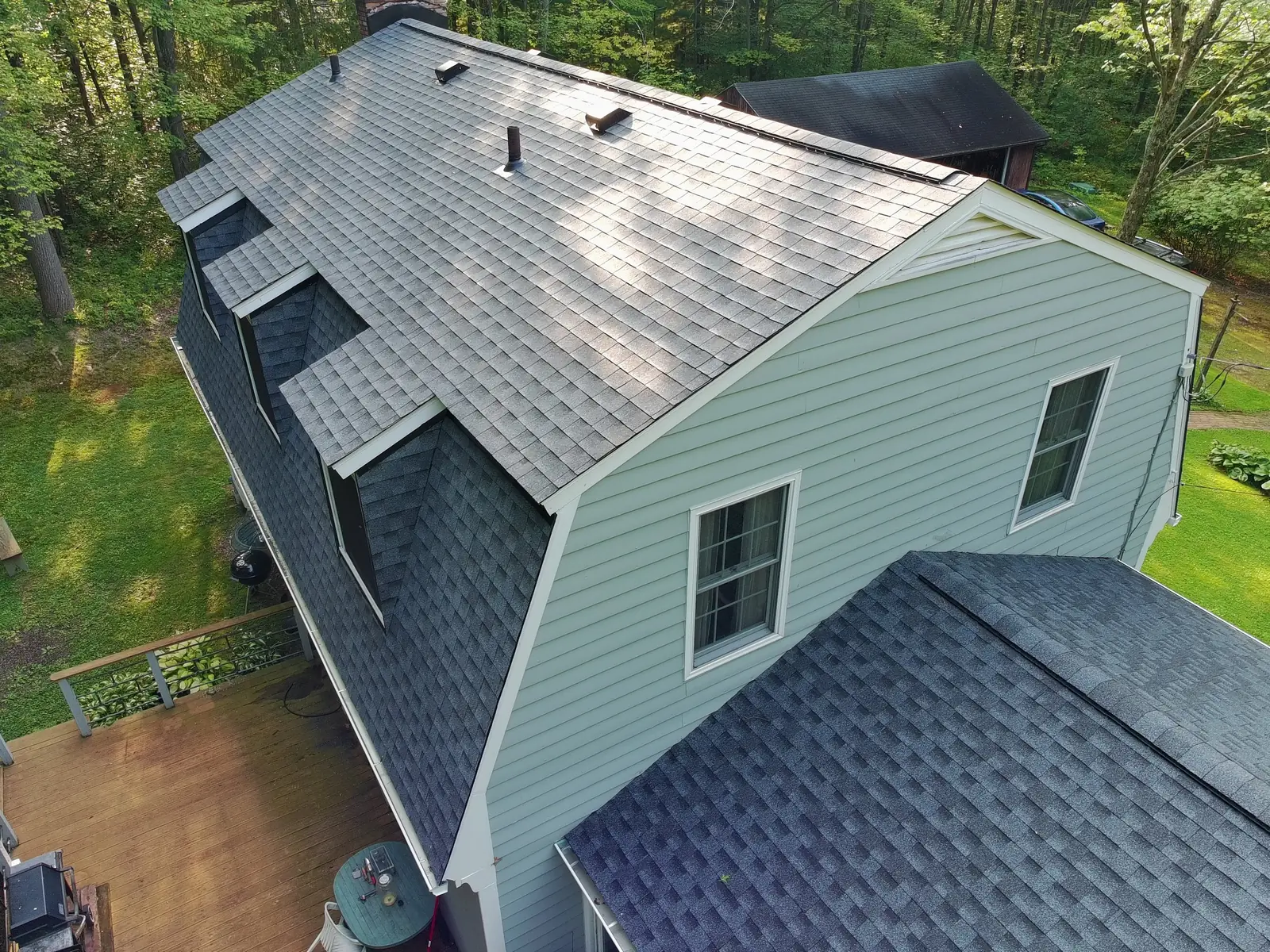
Aerial photos cover the whole roof.
Tap the roof
What an adjuster looks for. And what we photograph.
This roof has eight trouble spots. Most homeowners can't see them from the ground. Find them all and you've run the same checklist we run on every inspection.

Start with any dot.
Each one opens what it is, why it matters for a claim, and what shows up in your photo report.
-
Hail bruises
What it is. Dark, soft spots where granules were knocked off and the mat underneath is bruised. Press one and it feels like a bruise on an apple.
Why it matters. This is the heart of most hail claims. Adjusters count hits inside a 10-by-10-foot test square, so we photograph and count them too.
In your photo report. A test-square photo with every hit marked and counted.
-
Creased and lifted shingles
What it is. A horizontal crease across the tab where wind folded it back, or a tab that no longer sits flat because its seal strip broke.
Why it matters. Wind damage can be a repair or a replacement depending on how many tabs are creased and whether the shingle can still be matched.
In your photo report. Close-ups of each crease, with a coin for scale.
-
Cracked pipe boot
What it is. The rubber collar around a vent pipe splits from sun and ice. It is a small part that causes a lot of ceiling stains.
Why it matters. It is easy to miss from the ground, and a slow leak here can soak insulation for months before anyone notices.
In your photo report. The boot from two angles, plus the attic underside.
-
Chimney flashing
What it is. The metal where the chimney meets the roof. Sealant dries out, edges lift, and water finds the gap.
Why it matters. Flashing failures get written off as maintenance unless the storm cause is documented.
In your photo report. Every side of the chimney, with sealant joints in close-up.
-
Ridge cap
What it is. The cap shingles along the peak take the most wind. Cracked or missing caps lose their seal first.
Why it matters. Ridge caps are often left off an initial estimate even when they are damaged.
In your photo report. The full ridge line, end to end.
-
Gutters and downspouts
What it is. Dented soft metal and granules in the gutter are hail evidence. Sagging runs mean the fascia behind them is wet.
Why it matters. Adjusters read dents in soft metals as proof of hail size and direction.
In your photo report. Dent close-ups, plus granules collected at the downspout.
-
Drip edge
What it is. The metal edge along the roof line. Bent or missing sections let water run behind the fascia.
Why it matters. Drip edge is a code item in many areas, and it is often missing from estimates.
In your photo report. Every eave and rake, with bends called out.
-
Attic and decking
What it is. From inside: daylight through boards, dark stains, damp insulation. The part nobody sees from the ground.
Why it matters. Wet decking changes the scope from shingles to shingles plus plywood.
In your photo report. Attic photos under every problem spot outside.
That's the checklist we run on every roof.
We are a roofing contractor, not a public adjuster. You file the claim; your insurer decides coverage; we document and build.
The claim, start to finish
Follow one claim from storm to new roof
Eight steps, and who does what at each one: you, Rocket, and your insurer. Your insurer decides coverage at every step.
-
1 The storm hits
- You
- Take photos from the ground if it is safe. Do not climb up. Call or text Rocket.
- Rocket
- Answers your call or text and gets an inspection on the calendar, same day or next day when we can.
- Insurer
- Nothing yet. You have not filed anything.
-
2 An inspection, with photos
- You
- Pick a time and be home if you can. There is nothing to sign.
- Rocket
- Goes on your roof and into your attic. Every issue is photographed, numbered and explained in plain English.
- Insurer
- Nothing yet. Looking at your roof does not file a claim.
-
3 You decide whether to file
- You
- With the photo report in hand, you choose. It is your policy and your call. Ask your agent how a claim could affect you.
- Rocket
- Answers your questions and gives you the documentation to hand over.
- Insurer
- Takes your claim and assigns an adjuster.
-
4 The adjuster is on your roof
- You
- Ask Rocket to be there. You can have your roofer present.
- Rocket
- Meets the adjuster on the roof, shows what was documented and answers their questions.
- Insurer
- Inspects the roof and writes an estimate.
We are a roofing contractor, not a public adjuster. You file the claim; your insurer decides coverage; we document and build.
-
5 The estimate arrives
- You
- Read it, check your deductible and coverage type, and send a copy to Rocket.
- Rocket
- Compares it line by line with what was found on your roof and flags anything that looks missing.
- Insurer
- Issues a coverage decision and an estimate. Coverage is their call.
-
6 Missed items get documented
- You
- Stay in the loop. You hear about every response.
- Rocket
- Documents each missed item with photos, code references and pricing, and submits a supplement for the repair scope.
- Insurer
- Reviews the supplement, then revises the estimate or explains why not.
-
7 Paperwork and funds
- You
- Sign your contract once scope and price are clear. Your deductible is due as your contract says.
- Rocket
- Goes over the scope and price with you before anything is signed.
- Insurer
- Issues payment, often made out to you and your lender.
We never pay, waive or rebate any part of your deductible. It is part of your contract with your insurer, and covering it can put your claim at risk.
-
8 New roof. Sun's out.
- You
- Walk the finished roof with Rocket.
- Rocket
- Installs the new roof and cleans up.
- Insurer
- Nothing more. The claim is done.
The line Rocket does not cross
- We never pay, waive or rebate any part of your deductible. It is part of your contract with your insurer, and covering it can put your claim at risk.
- We are a roofing contractor, not a public adjuster. You file the claim; your insurer decides coverage; we document and build.
- We never ask you to assign your claim to us or give us power of attorney. The claim stays yours.
Check your estimate
What did your estimate leave off?
These line items are often missing from a first insurance estimate. Hold your estimate next to this list and look for each one.
Drip edge
The metal edge at the eaves and rakes. Many codes require it, and it is easy to leave off.
Ice and water barrier
Self-sealing membrane at the eaves and valleys that stops ice dams and wind-driven rain from getting in.
Starter strip
The first course of shingles that seals the roof edge against wind.
Ridge and hip caps
Cap shingles are a separate line from the field shingles.
Pipe boots and vent flashing
Every pipe and vent through the roof needs new flashing.
Chimney and step flashing
The metal where the roof meets walls and chimneys.
Extra layers of tear-off
A second layer of old shingles costs more to remove and haul away.
Decking repair
Rotted or damaged roof boards, usually priced per sheet and found once the old roof is off.
Permit and disposal
Most towns require a permit, and the old roof has to go somewhere.
Ventilation
Ridge, roof or soffit vents that keep the attic dry and help the shingles last.
Whether any of these belongs on your estimate depends on your policy and local code. Your insurer decides coverage.
We are a roofing contractor, not a public adjuster. You file the claim; your insurer decides coverage; we document and build.
Answers first
Storm damage questions
How do I know if hail damaged my roof?
Usually you can't tell from the ground. Look for dented gutters, vents or mailboxes, and granules in the downspouts. Then get someone on the roof with a camera. Our inspection is free.
Should I call my insurance company first?
Many homeowners have us look first, so they know what's up there before they talk to their insurer. An inspection does not file a claim.
Will insurance pay for a new roof?
If a covered storm damaged your roof, your policy may pay to repair or replace it, minus your deductible. Your insurer decides coverage. We document the damage so you know where you stand.
Will you cover my deductible?
We never pay, waive or rebate any part of your deductible. It is part of your contract with your insurer, and covering it can put your claim at risk.
Is there a deadline to file a claim?
Policies have time limits that vary by insurer. Check your policy or ask your agent, and don't wait. Damage that isn't documented soon after a storm is harder to connect to it.
Service area
Storm Damage Repair in Akron and Northeast Ohio
Book the free inspection. Here's exactly what happens.
Pick a time. A Rocket roofer gets on your roof and photographs everything. Then we sit down with you, go over every photo and lay out your options. About an hour, and nothing to sign that day.